

Dr. Manuel Chacón-Quirós Publishes a New Conceptual Framework in Clinics in Plastic Surgery
Scientific article published in 2025 redefines the fundamental principles of breast augmentation surgery.
Breast augmentation surgery, one of the most frequently performed aesthetic procedures worldwide, is undergoing a fundamental transformation. Dr. Manuel Chacón-Quirós, from the Department of Plastic Surgery at the European Center of Surgery in San José, Costa Rica, has published a comprehensive scientific article introducing the concept of Breast Tissue Preservation (BTP) as a new paradigm in aesthetic breast surgery.
Published in Clinics in Plastic Surgery (2025), this work represents a comprehensive synthesis of years of clinical research and technical development aimed at minimizing surgical trauma while maximizing the anatomical and functional integrity of breast tissue.
What is Breast Tissue Preservation (BTP)?
Definition and Philosophy
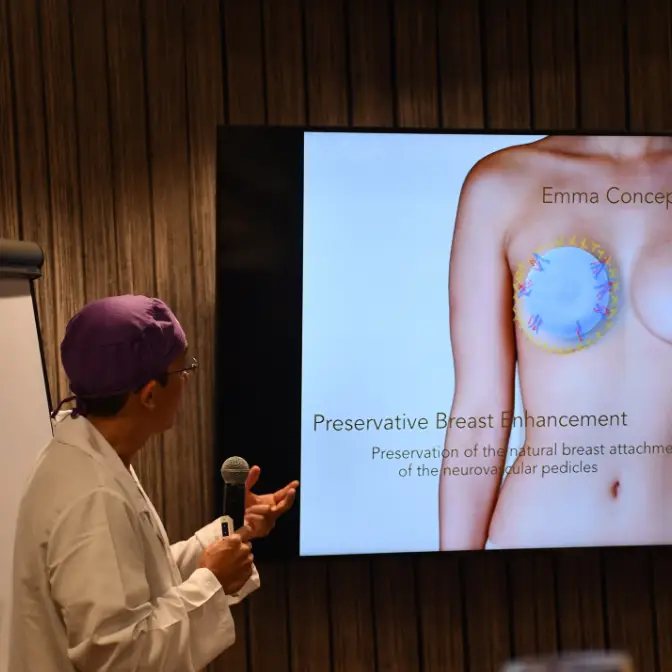
Breast Tissue Preservation (BTP) is an advanced surgical concept representing a transformative advancement in aesthetic breast surgery. While conventional augmentation techniques typically focus on increasing volume and reshaping the breast, they may alter the tissue’s foundational integrity.
BTP is based on a conceptual framework that prioritizes:
- Identifying the patient’s native anatomy
- Using a surgical approach designed to maintain structural and functional tissue integrity
- Employing minimally invasive and atraumatic methods
At its core, BTP seeks to minimize surgical disruption through:
- Specialized minimally invasive instrumentation
- Precise 3D planning
- Preservation of natural tissue planes
The 4 Levels of Breast Tissue Preservation
Dr. Chacón structures the BTP concept into four fundamental levels that address different aspects of tissue integrity.
Level 1: Cellular
The cellular level focuses not only on minimizing trauma but also on actively preserving the biological integrity of native breast tissue by modulating the foreign body response (FBR) during and after surgery.
4-micron surface implants: Research has shown that implants with a 4-micron surface provoke the lowest inflammatory response compared with traditional smooth, microtextured, and macrotextured surfaces. This topography was specifically designed to:
- Improve biocompatibility
- Minimize tissue disruption
- Suppress FBR and fibrosis through higher levels of FOXP3+ regulatory T cells
This unique behavior correlates with clinical evidence of low capsular contracture rates regardless of implant placement above or below the pectoralis major muscle.
Level 2: Structural
The structural level emphasizes preserving the breast’s native anatomical framework by respecting the fascial and ligamentous networks that play a critical role in long-term stability and optimal implant positioning.
Circummammary Ligament (CML): The posterior extensions of Cooper’s ligaments connect with the circummammary ligament (CML), a dense fibrous ring that surrounds the breast tissue and provides structural support.
This ligament:
- Anchors the breast to the chest wall
- Defines a natural boundary between fascial layers
- Preserves vascular and lymphatic integrity
- Facilitates uniform mechanical force distribution
Prepectoral placement: Placing the implant in a prepectoral pocket preserves the pectoralis major muscle, maintaining chest and upper arm function while minimizing complications such as animation deformity.
An IRB-approved prospective study of 100 patients using the BTP technique reported a 0% incidence of inferior malposition at 3 years, underscoring the importance of preserving the breast’s native support structures
Level 3: Dynamic
The dynamic level relates to the breast’s spatial projection and movement behavior, represented through the Pre-existing Breast Volume and Projection.
Breast Topography: To evaluate and plan augmentation dynamically, the BTP approach uses the concept of Breast Topography, a mapping system that visualizes Breast Volume Distribution (BVD) across the chest. This tool identifies natural areas of prominence and deficiency, enabling precise implant placement within the preserved tissue envelope.
The M Line: A key reference point within this mapping is the M Line, a horizontal line positioned 1–1.5 cm above the upper border of the areola. This line represents the apparent transition zone between the chest wall and the projecting breast mound, serving both as a surgical reference point and as a communication tool during patient consultations.
The M Line helps clarify that, in most patients, the primary volumetric deficiency is located in the upper pole, making it the first target for augmentation.
The second objective is to improve medial cleavage, which is often compromised by lateral breast orientation, the natural slope of the rib cage, or low native volume.
The outcome of this dynamic concept is a lighter breast that is proportional, stable with natural movement, and organically contoured rather than heavy or overloaded with unnecessary implant volume.
Level 4: Functional
El nivel funcional de BTP se enfoca en preservar sistemas fisiológicos clave esenciales para la calidad de vida postoperatoria:
Sensory preservation: Sensory integrity particularly of the nipple–areola complex (NAC) is a fundamental component of functional breast surgery. BTP techniques prioritize protection of the anterior branches of the fourth and fifth intercostal nerves, which are primarily responsible for afferent innervation in this region.
Placing the incision along the inframammary fold (IMF) especially when slightly lateralized to the 5 o’clock and 7 o’clock positions plays a significant role in protecting these nerves.
Clinical follow-up data reports no loss of NAC sensation, reinforcing the neuroprotective potential of this approach.
Preservation of muscular anatomy: Conventional submuscular implant placement often requires detachment or manipulation of the pectoralis major muscle (PMM), which has been associated with postoperative discomfort, animation deformity, and delayed recovery.
BTP employs a prepectoral approach, thereby preserving the structural and functional integrity of the PMM. This technique minimizes complications commonly associated with submuscular disruption and helps maintain the mechanical function of the upper thoracic girdle.
Lifestyle preservation: The atraumatic nature of BTP, combined with preservation of neurovascular and musculoskeletal structures, allows for earlier recovery compared with conventional augmentation techniques.
Patients can typically resume light daily activities within the first postoperative week, sometimes as early as immediately after surgery, with a gradual return to more strenuous tasks over 2 to 3 weeks, based on individual tolerance and clinical guidance.
This accelerated functional recovery reflects the lower inflammatory and mechanical burden inherent to this approach.
Technologies Used in BTP
The BTP approach uses a specialized set of technologies designed to preserve native anatomical structures through atraumatic dissection and precise implant placement.
1. Tunneling Technology
Tunneling is a minimally invasive technique used to access the implant pocket through a narrow anatomical corridor, typically originating from the axillary fold or the IMF.
A 2 cm diameter tunnel is created with a specialized instrument featuring a tip that navigates atraumatically and precisely through the CML, 1 cm above the PMM fascia, toward the posterior aspect of the mammary gland.
This space is located directly behind the pseudocapsule of the corpus mammae and within the posterior lamellar fat of the superficial fascia.
Importantly, this trajectory respects the boundaries of the CML and preserves both Cooper’s ligaments and the deep fascial layers, enabling controlled and consistent tunneling through tissue planes.
2. Inflatable Balloon System
After tunneling, an inflatable balloon (IB) with an integrated handle is introduced to support controlled expansion. The balloon is inserted deflated and then incrementally inflated to achieve mechanical tissue-plane elongation and hemostasis, rather than disruption through blunt or sharp dissection.
This system allows radial expansion that respects the breast’s fascial and ligamentous architecture. The diameter and geometry of this balloon create a 3D space with dimensions equivalent to the implant that will subsequently be placed, enabling a snug, controlled pocket within the limits of the CML.
This approach contrasts with pocket creation using electrocautery, which may lead to complications such as:
- Devitalization of breast tissue
- Disruption of sensory nerves causing pain
- Inadequate hemostasis
- Thermal tissue injury to skin flaps
The controlled balloon-based elongation technique:
- Preserves neurovascular integrity
- Prevents over-dissection
- Supports long-term implant stability and sensory function
- Enables natural implant movement within a preserved tissue matrix
3. Implant Insertion System
Atraumatic, no-touch implant insertion is critical to maintaining tissue integrity and reducing the risk of contamination and postoperative complications.
BTP uses sterile insertion systems to allow controlled implant placement through small incisions without excessive manipulation of the device or surrounding tissue.
For IMF incisions: A funnel can be used effectively to access the BTP Space.
For the transaxillary approach: Implant insertion is performed using a validated pneumatic injector, ensuring safe delivery of the implant through the transaxillary incision along its long trajectory toward the BTP Space.
4. Advanced Implant Design
As mentioned previously, breast implants used in BTP are characterized by their 4-micron, low-inflammation, biocompatible surface properties, which are better suited for prepectoral placement.
This practice has shown favorable outcomes in minimizing capsular contracture risk and preserving long-term breast softness.
Implant composition: Beyond surface topography, implant composition plays a pivotal role in functional and aesthetic outcomes. Highly adaptable shells and cohesive gel constructions are designed to mimic the viscoelastic behavior of native breast tissue.
Following ergonomic principles, their dynamic response to pressure allows the implant to move synchronously with the body, adapting to positional changes while maintaining a natural breast contour.
For the transaxillary approach: A specially designed implant with a lentiform geometry eliminates the risk of anterior or posterior malposition. Its projection-to-diameter relationship enables reduced implant volume while achieving the desired increase in cup size.
Key Concepts Introduced by BTP
1. Nesting
The nesting concept represents a fundamental evolution in breast surgery introduced through the BTP approach. It redefines implant integration not as the insertion of a foreign volume into a surgically dissected space, but as the biomechanically and biologically harmonious placement of an implant within a preserved, native tissue envelope.
Central to this concept is the use of the IB system, which enables controlled multidirectional tissue-plane elongation rather than disruption through blunt cutting or cautery.
The balloon expands the pocket:
- Superiorly
- Medially
- Laterally
- Inferiorly
- Anteriorly
Creating a well-defined 3D space within the breast while preserving critical structures including fascia, Cooper’s ligaments, and neurovascular elements.
The biological “nest” created by this method:
- Provides intrinsic positional stability without relying on muscle compression
- Preserves implant mobility and dynamic response
- Minimizes capsular formation due to reduced tissue trauma
- Improves aesthetic softness and reduces implant palpability
Importantly, this BTP Space is adaptive rather than static, conforming to the implant’s contour and consistency. The nest allows the use of smaller base-width implants while achieving adequate projection and volume.
2. Breast Tissue Recruitment
Breast tissue recruitment is a central principle of BTP that emphasizes the strategic use of native anatomical tissue over prosthetic substitution.
Rather than simply displacing tissue, it involves repositioning and mobilizing underutilized native breast tissue based on a deeper understanding of breast topography and volumetric distribution.
Underappreciated upper pole tissue: Conventional approaches often fail to consider tissue present in the upper breast, especially the area between the M Line and the superior border of the CML, leading to excessive reliance on implant volume to achieve shape.This region contains structurally functional tissue that is often overlooked during augmentation planning and surgical implant placement. With the development of breast topography, this neglected volume was quantified and found to contribute up to 30% of total breast volume.
By recruiting this underappreciated tissue, BTP enables:
- Proper implant sizing within anatomical limits
- Preservation of the natural IMF
- Optimization of natural results through anatomical efficiency
This repositioned volume contributes to:
- Improved upper pole fullness
- Better implant coverage
- Better aesthetic results without increasing the surgical footprint
3. Tent Effect
The Tent Effect refers to the geometric contribution of implant design to vertical projection and central volume, independent of lateral expansion or increasing device size.
In the context of BTP, the Tent Effect allows surgeons to achieve vertical lift and upper pole enhancement without compromising preserved anatomy or increasing incision size.
Key outcomes associated with the Tent Effect:
- Increased central projection with minimal lateral spread
- Improved upper and medial pole fullness, contributing to improved cleavage
- Selection of lower-volume implants, reducing tension on the lower pole and IMF
- Improved volumetric distribution that conforms to the preserved anatomical envelope
This geometric strategy is synergistic with the nesting concept, as it allows implants to settle naturally into the adaptive pocket created through balloon-based elongation.
4. Implant Positioning
Implant positioning in the context of BTP is governed by anatomical adaptation rather than forced dissection, complicated technical maneuvers, or artificial fixation through implant texturization, which may be associated with rare lymphoproliferative diseases such as breast implant-associated anaplastic large cell lymphoma (BIA-ALCL).
The nesting effect and multidirectional tissue elongation create a biologically compliant pocket in which the implant settles with predictable spatial orientation.
Consistent observation: A consistent observation in BTP cases is that implants tend to assume a position approximately 1 cm higher than in conventional augmentation techniques.
This elevated positioning enables recruitment of upper pole tissue specifically between the M Line and the CML improving both projection and soft-tissue coverage.
Surgical advantages:
- Optimal, selective pocket positioning and implant placement aligned with volumetric deficiency
- Reduced base width due to improved medial and lateral tissue support
- A narrower, more projected breast contour with reduced lateral spill
- Less volume directed to the lower pole, which in most cases naturally contains greater native tissue mass
Specific BTP Procedures
Mia Femtech™: Transaxillary Approach
Mia Femtech is a minimally invasive breast harmonization technique designed for patients seeking a subtle enhancement of 1 to 2 cup sizes with minimal recovery time.
Key Features:
- Outpatient procedure under local anesthesia with or without light sedation
- No breast incisions; single entry point via a 2.5–3 cm transaxillary incision
- Rapid recovery: patients typically return to daily activities within 24–48 hours
Step-by-Step Description:
- Preoperative Planning: Assessment of breast topography and identification of the M Line to guide volume distribution and implant positioning
- Tumescent Local Anesthesia (TLA) Infiltration: A modified Klein solution is prepared and delivered under ultrasound guidance to achieve anesthesia, hydrodissection, and vasoconstriction within the BTP Space. Total volume per breast ranges between 120 and 150 cc
- Tunneling: A prepectoral tunnel is created from the transaxillary fold toward the medial inframammary pole using the Motiva Channel Separator
- Pocket Creation: The Motiva Inflatable Balloon is used to elongate tissue planes, forming a preserved 3D pocket without blunt or sharp dissection
- Implant Delivery: The implant is injected using the Motiva Injector for minimal handling
- Implant Selection: The Motiva SmoothSilk Ergonomix2 Diamond silicone gel-filled breast implant is used. It features lentiform geometry for consistent projection regardless of implant orientation. Available in low, medium, high, and extra-high projections with volumes ranging from 95 to 195 cc
- Closure and Recovery: The skin is closed using a single intradermal suture. No drains are required, and patients experience immediate return to daily routine with gradual return to exercise
Preservé™: Inframammary Fold Approach
Preservé is a less invasive BTP procedure designed for a broader breast augmentation population—specifically for patients seeking enhanced volume while maintaining tissue preservation.
Key Features:
- Performed under local anesthesia with sedation or general anesthesia, depending on the surgical plan
- Accommodates a wider range of anatomical variations in routine augmentation procedures up to 4 cup sizes
- Single entry point through a 2.5–3 cm IMF incision
- Rapid recovery: patients typically return to daily activities within 1 week
- Allows improved control over volume distribution and breast contouring; compatible with a hybrid approach
Step-by-Step Description:
- Preoperative Planning: Breast topography analysis is used to identify areas of tissue deficiency. Implant selection is guided by native anatomical limits (e.g., CML), implant height, and projection characteristics
- TLA Infiltration: Same as the transaxillary approach
- Tunneling: A prepectoral tunnel is created via a 2.5–3 cm IMF incision using the Motiva Channel Separator
- Pocket Creation: The Motiva Inflatable Balloon is used for atraumatic tissue expansion and 3D pocket creation
- Implant Placement: The implant is inserted using the Motiva Insertion Sleeve
- Implant Selection: The Motiva SmoothSilk Ergonomix2 silicone gel-filled breast implant is used. Available in low, medium, and high projections with volumes ranging from 95 to 330 cc
- Closure and Recovery: The skin is closed using a single intradermal suture. No drains are required, and patients experience a rapid return to daily activities
Clinical Results
Evidence supporting the BTP concept is demonstrated through data from the prospective Mia Femtech study of 100 consecutive patients, which evaluated outcomes of its minimally invasive breast harmonization technique.
Key study findings:
- Low rate of device- and technique-related complications: 3.2%
- No loss of nipple or breast skin sensation at 3-year follow-up
- These data underscore BTP’s potential to deliver clinical safety
Source: https://www.sciencedirect.com/science/article/abs/pii/S0094129825001075
Creator: Dr. Manuel Chacón